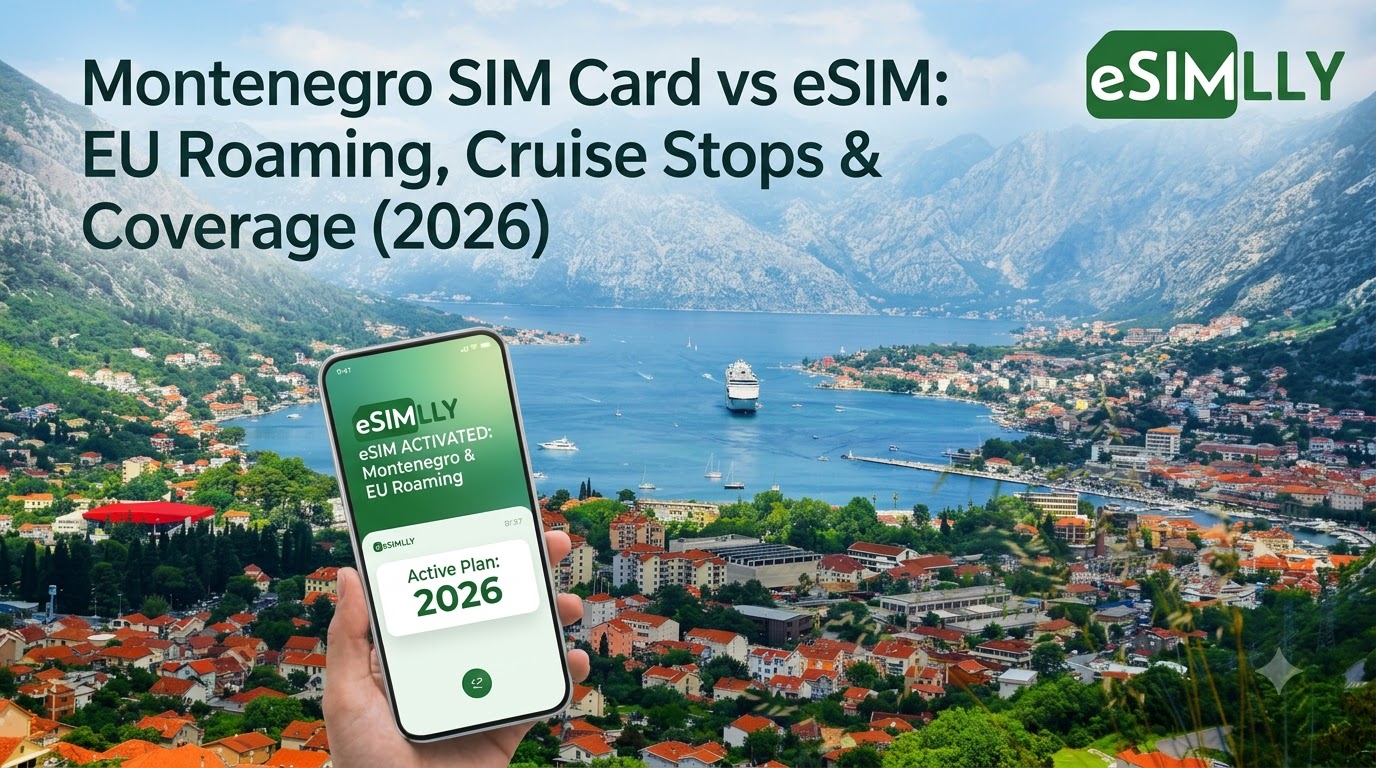
Montenegro SIM Card vs eSIM: EU Roaming, Cruise Stops & Coverage (2026)
Montenegro isn't in EU Roam Like at Home. Compare tourist SIMs and eSIMs for Kotor, Budva and Durmitor, including cruise day stops. Plans from $2.
ReadAuthor
Angelus Sharma
Published
July 31, 2026

As eSIM technology becomes the new standard for smartphones, tablets, smartwatches, and laptops, one question continues to appear among first-time users:
"Are eSIMs actually safe?"
It's a reasonable concern. Your mobile connection is linked to sensitive parts of your digital life, including banking apps, social media accounts, email, cloud storage, two-factor authentication (2FA), and personal conversations. Choosing how your device connects to mobile networks is therefore an important security decision.
The good news is that eSIM technology was designed with security in mind. In many situations, an eSIM can actually provide security advantages over a traditional physical SIM card because it cannot be removed from your phone as easily and relies on secure digital provisioning standards developed by the mobile industry.
However, like any technology, an eSIM is not immune to risks. While the technology itself is highly secure, your overall security still depends on how you protect your device, your online accounts, and your mobile service.
This guide explains how eSIM security works, what threats still exist, how eSIMs compare with physical SIM cards, and the best practices every traveller should follow.
An eSIM (Embedded SIM) is a programmable SIM built directly into compatible devices.
Unlike a plastic SIM card that can be removed from a SIM tray, an eSIM is soldered into the device during manufacturing and stores mobile subscription information digitally.
To activate an eSIM, users typically:
Purchase a mobile plan.
Receive activation instructions or a QR code.
Download the carrier profile securely.
Activate the plan.
Once installed, the eSIM functions similarly to a traditional SIM card but without requiring physical hardware replacement.
In many situations, yes.
Although both technologies use secure mobile network authentication, eSIMs remove several risks associated with removable SIM cards.
A traditional SIM card can:
Be removed from the device.
Be lost while travelling.
Be stolen.
Be damaged.
Be swapped into another phone.
An eSIM:
Cannot simply be removed by opening the SIM tray.
Remains securely embedded inside the device.
Reduces the chance of accidental loss.
Eliminates handling of tiny SIM cards.
Makes physical theft of the SIM more difficult.
This provides an additional layer of physical security.
Modern eSIM technology follows globally recognised industry standards for secure provisioning and authentication.
During activation:
The device communicates securely with the provider.
Subscriber information is encrypted during delivery.
The eSIM profile is downloaded digitally.
Authentication occurs before network access is granted.
This secure provisioning process is one reason eSIM adoption continues to grow worldwide.
This is one of the most misunderstood topics.
SIM swap fraud occurs when criminals convince a mobile carrier to transfer a victim's phone number to another SIM or eSIM under their control.
Once successful, they may receive:
SMS verification codes.
Banking authentication messages.
Password reset codes.
The attack targets your mobile account, not the physical SIM technology itself.
Not automatically.
If an attacker successfully convinces your carrier to move your mobile number to another SIM or eSIM, the fraud can still occur.
What protects you is:
Strong carrier identity verification.
Secure account recovery processes.
Multi-factor authentication.
Good account security.
In other words, eSIMs reduce certain physical risks but do not eliminate account takeover attacks.
Yes—from a physical perspective.
If someone steals your phone:
They cannot simply eject your eSIM using a SIM tool.
They cannot immediately insert your eSIM into another device.
However, if they gain access to your unlocked phone and your online accounts, they may still be able to misuse your information.
Protecting the device itself remains essential.
For international travellers, an eSIM offers several security advantages.
Because there is:
No SIM card to lose.
No SIM tray to open.
No need to store your home SIM in a wallet or hotel room.
Many travellers reduce the risk of misplacing or damaging their primary SIM card during a trip.
An eSIM does not automatically make your internet activity anonymous.
Just like a physical SIM, your privacy depends on:
The websites you visit.
Apps you use.
Permissions you grant.
Network security.
Your device settings.
An eSIM protects your mobile subscription, but it does not replace good online privacy practices.
An eSIM itself does not introduce new tracking capabilities compared with a traditional SIM.
Location information is handled by the mobile network in much the same way for both physical SIMs and eSIMs.
The main sources of location tracking today are often:
Smartphone apps.
GPS services.
Bluetooth.
Wi-Fi location services.
Device permissions.
Managing app permissions is usually more important than the type of SIM you use.
In many situations, yes.
Public Wi-Fi networks may expose users to risks such as:
Fake hotspots.
Unencrypted connections.
Network interception.
Malicious login portals.
Using your own mobile data connection through a trusted eSIM provider can often be a more secure option than relying exclusively on public Wi-Fi.
For highly sensitive work, many professionals also use a reputable VPN in addition to their mobile connection.
Whether you're travelling or using an eSIM at home, these habits improve your security.
Always enable:
Face ID
Fingerprint authentication
Strong PIN
Password
A locked phone is your first line of defence.
Protect important accounts such as:
Banking
Cloud storage
Social media
Where possible, consider using an authenticator app rather than relying solely on SMS-based verification.
Install updates for:
Operating system
Security patches
Apps
Updates often include fixes for newly discovered vulnerabilities.
Avoid downloading eSIM profiles from unknown or unofficial sources.
Always purchase plans through legitimate providers and follow their official activation instructions.
Your activation QR code contains information needed to provision your eSIM.
Treat it like sensitive information:
Don't share screenshots publicly.
Delete unnecessary copies after installation if appropriate.
Follow your provider's guidance on retaining activation details.
Use:
Strong passwords.
Account PINs where available.
Recovery information you control.
Many mobile carriers allow additional account-level security features.
Corporate travellers often access:
Company email.
Cloud storage.
Customer databases.
Financial systems.
Using an eSIM together with:
Device encryption.
VPNs.
Strong authentication.
Mobile device management (MDM), where applicable.
can help support secure remote work practices.
False.
There is no evidence that eSIM technology itself is inherently easier to compromise than traditional SIM technology.
False.
An eSIM is a method of provisioning mobile service, not an anonymity tool.
Not necessarily.
Physical SIMs can be lost, stolen, or removed more easily than embedded eSIMs.
False.
Strong passwords, software updates, and good digital habits remain essential regardless of which SIM technology you use.
As more smartphones become eSIM-first or eSIM-only, security continues to improve through:
Enhanced device authentication.
Stronger carrier verification.
Better remote provisioning.
Improved account protection.
Wider adoption of digital identity verification.
Industry trends suggest that eSIM technology will play a central role in the future of secure mobile communications.
Why Travelers Choose eSIMLLY
Security and convenience go hand in hand when travelling internationally.
eSIMLLY provides travel eSIM services in more than 160 countries and regions, helping travellers stay connected through reliable mobile data without the inconvenience of swapping physical SIM cards. With instant digital delivery, transparent pricing, and straightforward activation, eSIMLLY makes it easy to prepare your connectivity before departure while benefiting from the security advantages of embedded SIM technology.
Whether you're travelling for business, leisure, study, or a multi-country adventure, eSIMLLY offers flexible travel eSIM plans designed to keep you connected wherever your journey takes you.
So, are eSIMs safe? For most users, the answer is yes. eSIM technology is built on secure industry standards and offers several practical security advantages over traditional removable SIM cards, particularly by reducing the risk of physical loss or theft.
That said, no technology can protect against every threat on its own. Your overall security still depends on protecting your device, securing your mobile account, keeping your software up to date, and practising good online security habits. When combined with these best practices, an eSIM provides a secure and convenient way to stay connected at home and while travelling.
The future of travel is connected, digital, and increasingly seamless—and embedded eSIMs are becoming one of the technologies making that future possible.
As more travellers, enterprises, and device manufacturers embrace eSIM technology, staying connected across borders is becoming simpler than ever. With eSIMLLY providing travel eSIM services in more than 160 countries and regions, international travellers can enjoy reliable mobile connectivity wherever their journey takes them.
Montenegro isn't in EU Roam Like at Home. Compare tourist SIMs and eSIMs for Kotor, Budva and Durmitor, including cruise day stops. Plans from $2.
Read
Zvartnots airport SIM or eSIM? Compare Armenia's operators, tourist bundle prices and when each option makes sense. eSIM plans from $2.50.
Read
Beeline, Kcell or Tele2? Why foreign phones on Kazakh SIMs need IMEI registration, and when a travel eSIM is easier. Plans from $1.50.
ReadGet instant data and savings on your next trip with eSIMLLY. Simple activation, no physical SIM card needed.


