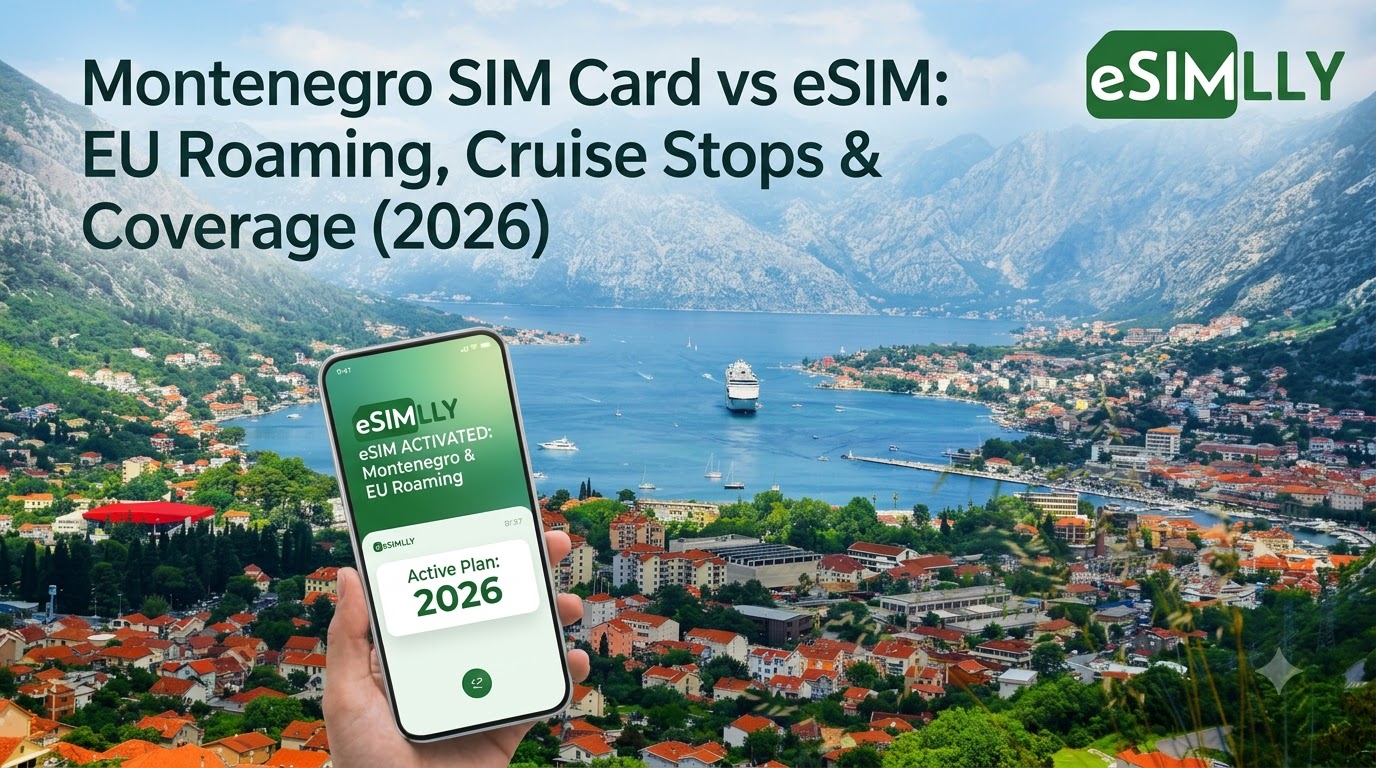
Montenegro SIM Card vs eSIM: EU Roaming, Cruise Stops & Coverage (2026)
Montenegro isn't in EU Roam Like at Home. Compare tourist SIMs and eSIMs for Kotor, Budva and Durmitor, including cruise day stops. Plans from $2.
ReadAuthor
Angelus Sharma
Published
July 31, 2026

The way people work has changed dramatically over the last few years. Millions of professionals no longer need to be tied to a traditional office. Instead, they work from cafés in Paris, coworking spaces in Bali, beachside apartments in Thailand, mountain towns in Portugal, or bustling cities like Tokyo and Dubai.
This new generation of digital nomads, freelancers, entrepreneurs, consultants, remote employees, and creators has one thing in common—they depend on a fast, reliable internet connection.
Without dependable mobile data, everyday tasks become difficult:
Joining Zoom meetings
Responding to Slack messages
Uploading large client files
Managing cloud storage
Using project management tools
Booking accommodation
Calling rides
Navigating unfamiliar cities
Managing online banking
Staying connected with family
While hotel Wi-Fi and public hotspots may seem convenient, they are often slow, overcrowded, unreliable, or insecure. That's why travel eSIMs have become one of the most valuable tools for modern remote workers.
In this comprehensive guide, you'll learn everything you need to know about choosing the best eSIM for digital nomads, what features matter most, how much data you'll need, and why an eSIM has become an essential part of the remote work toolkit.
Unlike vacation travellers who mainly use maps and messaging apps, digital nomads often rely on internet connectivity for their livelihood.
A few hours without internet can mean:
Missing an important client meeting
Delayed project delivery
Lost freelance opportunities
Missed deadlines
Communication breakdowns
Financial losses
Reliable mobile connectivity isn't just convenient—it's business critical.
An eSIM (Embedded SIM) is a digital SIM built directly into compatible smartphones, tablets, and laptops.
Instead of purchasing and inserting a physical SIM card, you simply:
Buy a travel plan online.
Receive a QR code.
Install the eSIM.
Activate it when your trip begins.
The entire process usually takes only a few minutes.
Digital nomads travel differently from tourists.
Many spend weeks or months moving between countries while working full-time.
An eSIM offers several advantages that make this lifestyle much easier.
After landing, you don't need to:
Visit mobile stores
Stand in airport queues
Carry passports for registration
Swap tiny SIM cards
Instead, your data plan is ready before departure.
For remote workers, every minute matters.
With an eSIM installed in advance, you can:
Book a taxi
Contact your accommodation
Check work messages
Join a meeting
Use navigation
Access online banking
within minutes of arriving.
Most modern smartphones support Dual SIM functionality.
This allows you to:
Keep your home SIM active for calls and SMS.
Use your travel eSIM for affordable mobile data.
This is particularly useful if your clients, employer, or bank still use your original phone number.
Traditional SIM cards are surprisingly easy to misplace.
Many travellers accidentally:
Leave them in hotel rooms.
Lose them while swapping.
Damage them during travel.
Because an eSIM is embedded into your device, there is nothing to remove or store.
Not every travel eSIM is equally suited for long-term remote work.
Here are the most important features to consider.
Many digital nomads travel across several countries in a single trip.
Examples include:
Portugal → Spain → France
Thailand → Vietnam → Malaysia
Japan → South Korea → Taiwan
USA → Canada → Mexico
Choosing an eSIM provider with broad international coverage makes these transitions much smoother.
Regional plans eliminate the need to purchase a new eSIM every time you cross a border.
Popular regions include:
Europe
Southeast Asia
North America
Middle East
Global plans
This is one of the biggest advantages for long-term travellers.
Remote workers have different usage patterns.
Some mainly:
Slack
Google Docs
Others regularly use:
Zoom
Microsoft Teams
Google Meet
Dropbox
Figma
GitHub
AWS
Cloud backups
A good provider should offer multiple plan sizes rather than only one or two options.
Your eSIM provider partners with local mobile operators.
Choosing a provider with reliable carrier agreements improves:
Speed
Coverage
Stability
Overall experience
If your trip is extended unexpectedly, adding more data should be quick and straightforward.
Look for providers that make purchasing another plan simple without requiring complicated setup.
Digital nomads typically consume much more data than casual tourists.
Here's a practical guide.
Typical activities:
Slack
Google Maps
Web browsing
Recommended:
10–15 GB per month
Typical activities:
Daily video meetings
Cloud storage
Social media
Music streaming
Recommended:
20–40 GB per month
Typical activities:
Multiple Zoom meetings
Large file uploads
Content creation
Frequent cloud backups
Streaming
Recommended:
40–60 GB+ per month
Activities:
4K video uploads
Live streaming
Social media publishing
Frequent backups
Recommended:
Large data plans or unlimited plans (where appropriate).
Many destinations have become popular among remote workers due to their affordable cost of living, excellent infrastructure, and growing coworking communities.
Known for:
Lisbon
Porto
Madeira
Excellent internet infrastructure and strong digital nomad community.
Popular cities:
Bangkok
Chiang Mai
Phuket
Affordable living with numerous coworking spaces.
A long-time favourite among freelancers and entrepreneurs thanks to its vibrant coworking culture and international community.
Barcelona, Valencia, and Madrid continue to attract remote workers looking for excellent infrastructure and quality of life.
Cities such as Ho Chi Minh City and Da Nang offer competitive living costs and fast internet.
Dubai has become a major hub for entrepreneurs, startups, and location-independent professionals.
Many digital nomads rely on public Wi-Fi to reduce costs.
However, public networks come with several drawbacks.
Slow speeds
Congested networks
Limited availability
Time restrictions
Login portals
Poor security
For important work such as client meetings or financial transactions, using your own mobile connection is generally a more reliable option.
When working internationally:
Enable two-factor authentication.
Keep your operating system updated.
Use a VPN on public Wi-Fi.
Lock your device with biometric authentication.
Avoid accessing sensitive business accounts on unsecured networks.
Back up important files regularly.
Your eSIM provides connectivity, but good cybersecurity habits remain essential.
Local phone number
Competitive domestic pricing
Suitable for very long stays
Instant activation
No physical SIM swapping
Multi-country support
Easy online purchase
Flexible regional plans
For digital nomads moving between countries, travel eSIMs generally offer far greater convenience.
Avoid these common issues:
Buying too little data.
Depending entirely on hotel Wi-Fi.
Waiting until arrival to purchase connectivity.
Forgetting to install the eSIM before departure.
Ignoring regional plans when visiting multiple countries.
Leaving automatic cloud backups enabled on mobile data.
Not carrying a power bank during long workdays.
Planning ahead helps ensure a smoother remote work experience.
To make the most of your travel eSIM:
Download offline maps before travelling.
Schedule large file uploads when connected to trusted Wi-Fi.
Use cloud collaboration tools efficiently.
Monitor your monthly data usage.
Keep a backup internet option if your work is mission-critical.
Enable Wi-Fi calling if supported by your carrier.
These small habits can improve both productivity and reliability.
When comparing providers, prioritise:
Coverage in your destination countries.
Flexible data allowances.
Regional travel plans.
Transparent pricing.
Reliable customer support.
Easy activation.
Straightforward account management.
Don't choose solely based on the lowest advertised price. Reliable connectivity is often far more valuable than saving a few dollars.
Remote work demands dependable connectivity wherever your journey takes you.
eSIMLLY provides travel eSIM services in more than 160 countries and regions, making it an excellent choice for freelancers, entrepreneurs, business travellers, and digital nomads. With destination-specific and regional plans, instant digital delivery, transparent pricing, and easy activation, you can install your eSIM before departure and stay connected across borders without the hassle of changing physical SIM cards.
Whether you're spending a month in Europe, working remotely from Southeast Asia, or travelling across multiple continents, eSIMLLY offers flexible travel eSIM solutions designed to support today's location-independent professionals.
Before choosing an eSIM for long-term travel, also think about:
Time zone differences for customer support.
Local network availability in rural areas.
Whether your phone supports multiple active SIMs.
The validity period of your plan.
Expected monthly data usage.
Future destinations if your itinerary changes.
A little planning before your trip can save both time and money later.
For digital nomads and remote workers, reliable internet is more than a convenience—it's the foundation of a productive workday. While public Wi-Fi and traditional roaming still have their place, travel eSIMs provide a flexible, modern solution that allows professionals to stay connected across borders without swapping physical SIM cards or worrying about unpredictable roaming charges.
Choosing the right provider comes down to your destinations, work requirements, expected data usage, and travel style. By selecting an eSIM with broad coverage, flexible plans, and dependable network partners, you can focus less on connectivity and more on growing your business, serving your clients, and enjoying the freedom that remote work makes possible.
The future of travel is connected, digital, and increasingly seamless—and embedded eSIMs are becoming one of the technologies making that future possible.
As more travellers, enterprises, and device manufacturers embrace eSIM technology, staying connected across borders is becoming simpler than ever. With eSIMLLY providing travel eSIM services in more than 160 countries and regions, international travellers can enjoy reliable mobile connectivity wherever their journey takes them.
Instant activation, hotspot included and no roaming fees in the destinations from this guide.
Montenegro isn't in EU Roam Like at Home. Compare tourist SIMs and eSIMs for Kotor, Budva and Durmitor, including cruise day stops. Plans from $2.
Read
Zvartnots airport SIM or eSIM? Compare Armenia's operators, tourist bundle prices and when each option makes sense. eSIM plans from $2.50.
Read
Beeline, Kcell or Tele2? Why foreign phones on Kazakh SIMs need IMEI registration, and when a travel eSIM is easier. Plans from $1.50.
ReadGet instant data and savings on your next trip with eSIMLLY. Simple activation, no physical SIM card needed.


