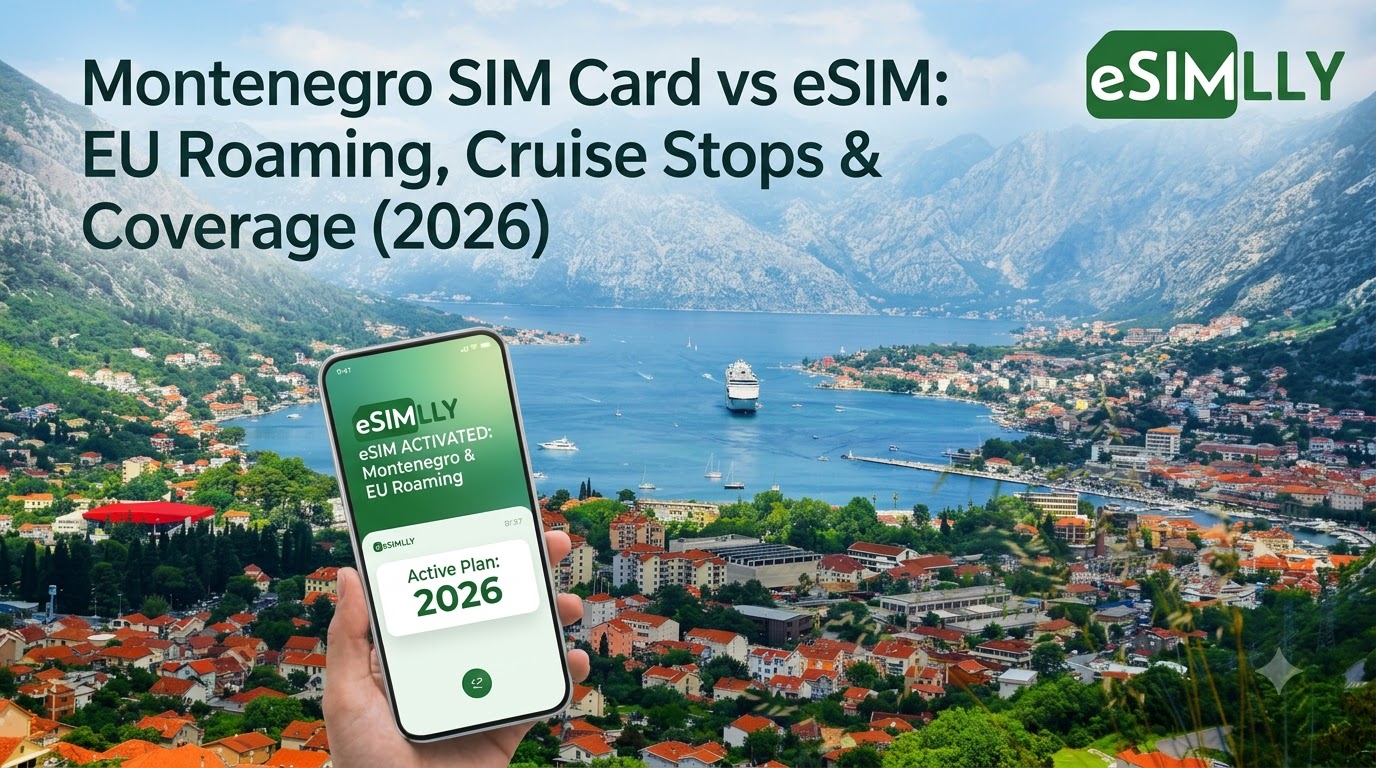
Montenegro SIM Card vs eSIM: EU Roaming, Cruise Stops & Coverage (2026)
Montenegro isn't in EU Roam Like at Home. Compare tourist SIMs and eSIMs for Kotor, Budva and Durmitor, including cruise day stops. Plans from $2.
ReadAuthor
Angelus Sharma
Published
July 27, 2026

Business travel has evolved dramatically over the past decade. Today's professionals rarely travel with printed itineraries, paper maps, or folders full of documents. Flights are booked online, boarding passes live on smartphones, meetings happen over video calls, and expense reports are submitted through mobile apps.
Yet one challenge has remained surprisingly outdated—staying connected while travelling internationally.
For years, companies relied on expensive roaming plans, reimbursed employees for local SIM cards, or distributed corporate SIMs before overseas trips. These approaches often created unnecessary costs, inconsistent connectivity, and administrative overhead.
In 2026, that model is changing rapidly.
Businesses of every size are adopting travel eSIMs as part of their corporate mobility strategy. Instead of managing physical SIM cards or unpredictable roaming bills, organisations can provide employees with digital connectivity before they even leave the office.
The result is faster onboarding, better productivity, simplified IT management, and more predictable travel expenses.
As global business travel continues to grow, company-managed travel eSIMs are becoming a standard tool for modern enterprises.
A business traveller is expected to be productive from the moment they arrive.
Within minutes of landing they may need to:
Join a video meeting
Respond to customer emails
Access cloud documents
Navigate to the office
Contact colleagues
Open CRM systems
Use collaboration tools
Approve transactions
Book transport
Without reliable internet, productivity stops.
Connectivity is no longer a convenience—it is part of the business infrastructure.
Many organisations still rely on international roaming.
While convenient, roaming creates several challenges.
Companies often struggle with:
High roaming charges
Unpredictable monthly bills
Limited visibility into usage
Country-specific pricing
Manual reimbursement claims
Inconsistent employee experiences
These issues become even more significant for organisations with frequent international travel.
Purchasing local SIM cards appears inexpensive, but the operational cost is much higher.
Employees often spend valuable time:
Finding a telecom store
Comparing plans
Waiting for activation
Configuring devices
Switching SIM cards
Recovering their home SIM later
Every hour spent solving connectivity is an hour not spent serving customers or attending meetings.
Travel eSIMs solve many of these operational problems.
Instead of distributing physical SIM cards, companies can provide digital connectivity before departure.
Employees simply:
Receive their travel plan
Install the eSIM
Activate it upon arrival
There is no physical logistics process.
Everything happens digitally.
Business trips often have tight schedules.
A sales executive landing at 8:00 AM may have a client meeting at 10:00 AM.
A consultant might need immediate access to cloud systems.
A project manager may need to coordinate teams across several countries.
Having internet available immediately allows employees to begin working without delays.
One of the biggest advantages of corporate eSIMs is simplified management.
Instead of handling physical SIM inventory, IT teams can manage travel connectivity digitally.
Benefits include:
Faster deployment
Easier provisioning
Simplified administration
Reduced logistics
Better visibility
Lower operational effort
For organisations with global teams, these efficiencies quickly add up.
Today's workforce is increasingly mobile.
Employees regularly work from:
Client offices
Airports
Hotels
Conferences
Co-working spaces
International branch offices
Reliable mobile connectivity allows professionals to remain productive regardless of location.
Sales professionals frequently travel across multiple countries.
Their success depends on uninterrupted communication.
They rely on:
CRM platforms
Video meetings
Digital contracts
Product demonstrations
Customer messaging
Navigation
Travel eSIMs help ensure connectivity remains available throughout every stage of the journey.
Many corporate itineraries involve several destinations.
For example:
London
Paris
Frankfurt
Amsterdam
Milan
Singapore
Tokyo
Seoul
Hong Kong
Sydney
New York
Toronto
Mexico City
Instead of changing SIM cards in every country, employees can activate regional travel plans that support multiple destinations.
Business travel is demanding.
Anything that reduces travel friction improves the employee experience.
Travel eSIMs eliminate common frustrations such as:
Airport SIM kiosks
Lost SIM cards
Manual setup
Language barriers
Roaming uncertainty
Employees spend less time solving connectivity issues and more time focusing on their work.
Managing physical SIM cards creates security risks.
Cards can be:
Lost
Damaged
Misplaced
Forgotten
Digital eSIM provisioning reduces many of these concerns.
Employees no longer need to remove their primary SIM card while travelling.
Many organisations allow employees to use personal smartphones for work.
eSIM technology complements this approach.
Employees can:
Keep their personal number
Use a separate travel data plan
Maintain work connectivity
Avoid carrying multiple phones
This creates a cleaner separation between personal and business usage.
Traditional roaming bills often arrive weeks after travel.
This makes budgeting difficult.
Prepaid travel eSIMs provide:
Predictable costs
Easier budgeting
Simpler reimbursement
Better travel planning
Finance teams benefit from clearer visibility into travel connectivity expenses.
Large organisations distribute thousands of SIM cards every year.
Replacing physical cards with digital provisioning reduces:
Plastic waste
Packaging
Shipping
Warehousing
Administrative handling
This supports broader corporate sustainability initiatives.
Company-managed travel eSIMs are particularly valuable for:
Consulting firms
Technology companies
Manufacturing businesses
Financial services
Pharmaceutical companies
Logistics providers
International sales organisations
Engineering firms
Energy companies
Professional services
Any organisation with internationally mobile employees can benefit.
Corporate mobility is becoming increasingly digital.
Future enterprise travel solutions are expected to integrate:
Travel booking
Expense management
Identity verification
Security policies
Connectivity provisioning
AI-powered travel assistance
Connectivity will become another automated part of the business travel workflow.
Employees may receive their travel eSIM automatically when a business trip is approved.
As international business travel becomes more frequent, organisations need a connectivity solution that is reliable, flexible, and easy to deploy.
eSIMLLY provides travel eSIM plans across more than 150 countries and regions, enabling companies to equip employees with digital mobile connectivity before they travel. Whether staff are attending international conferences, visiting clients, supporting overseas projects, or travelling across multiple countries, eSIMLLY helps reduce dependence on physical SIM cards and expensive roaming while simplifying the employee travel experience.
With straightforward activation, global coverage, and flexible data plans, eSIMLLY supports the needs of today's increasingly mobile workforce.
Business travel is no longer just about moving people between countries—it's about keeping them connected, productive, and secure throughout the journey.
Traditional roaming and physical SIM cards were designed for a different era. Modern enterprises need connectivity that can be deployed instantly, managed centrally, and adapted to changing travel requirements.
Travel eSIMs meet those expectations.
By giving employees immediate access to mobile data, simplifying IT operations, improving budgeting, and reducing travel friction, company-managed eSIMs are becoming an essential part of enterprise mobility.
As organisations continue to embrace digital-first business travel, eSIM technology is set to play an increasingly important role in how global teams work, collaborate, and stay connected—wherever business takes them.
As more travellers, enterprises, and device manufacturers embrace eSIM technology, China is set to become one of the most influential markets in shaping the future of mobile communication—and providers like eSIMLLY are well positioned to help international travellers stay connected across China and more than 150 destinations worldwide.
Instant activation, hotspot included and no roaming fees in the destinations from this guide.
Montenegro isn't in EU Roam Like at Home. Compare tourist SIMs and eSIMs for Kotor, Budva and Durmitor, including cruise day stops. Plans from $2.
Read
Zvartnots airport SIM or eSIM? Compare Armenia's operators, tourist bundle prices and when each option makes sense. eSIM plans from $2.50.
Read
Beeline, Kcell or Tele2? Why foreign phones on Kazakh SIMs need IMEI registration, and when a travel eSIM is easier. Plans from $1.50.
ReadGet instant data and savings on your next trip with eSIMLLY. Simple activation, no physical SIM card needed.


