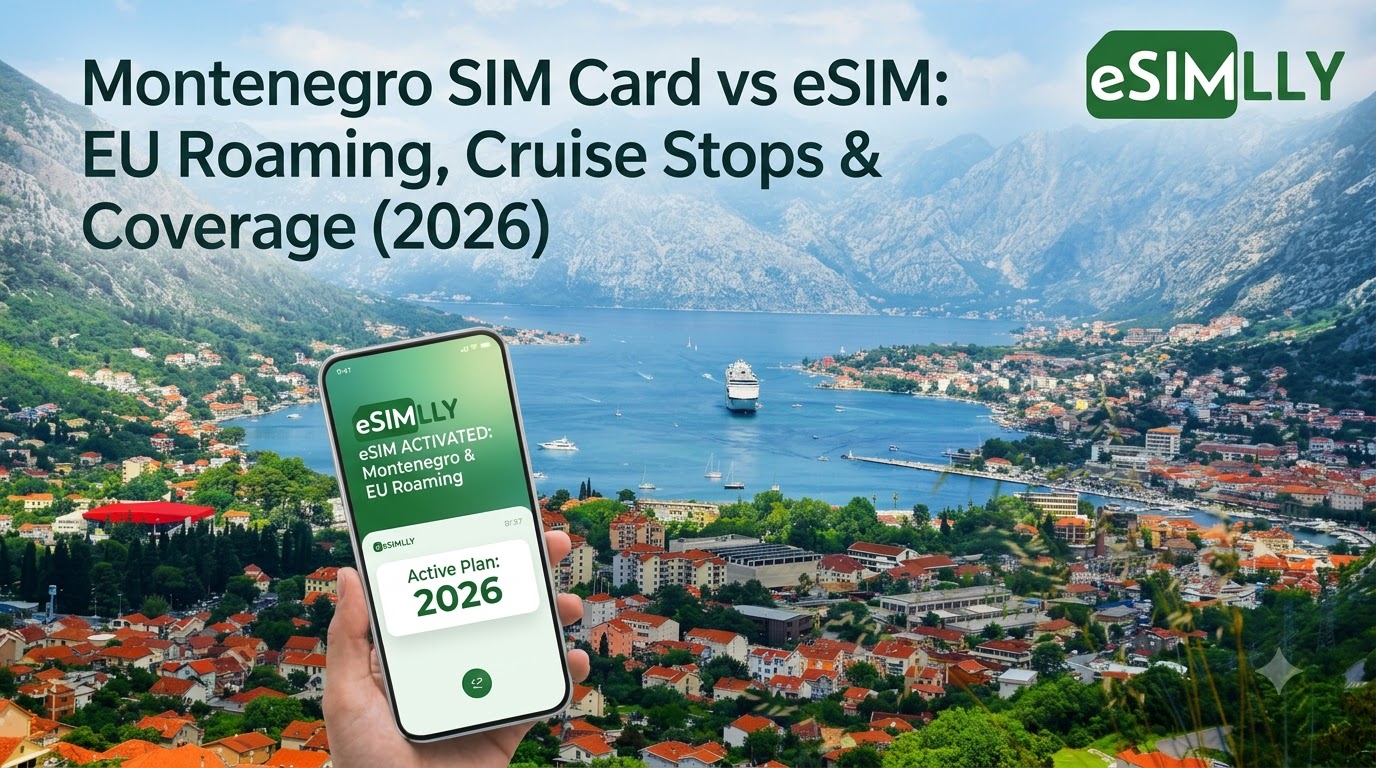
Montenegro SIM Card vs eSIM: EU Roaming, Cruise Stops & Coverage (2026)
Montenegro isn't in EU Roam Like at Home. Compare tourist SIMs and eSIMs for Kotor, Budva and Durmitor, including cruise day stops. Plans from $2.
ReadAuthor
Angelus Sharma
Published
July 31, 2026

Few travel experiences are more frustrating than returning home from an amazing international trip only to discover an unexpectedly high mobile phone bill.
For years, international roaming charges have caught travellers off guard. A few video calls, some map navigation, uploading holiday photos, or simply leaving mobile data turned on in the background can quickly result in charges that exceed the cost of flights or accommodation.
Although many mobile carriers now offer international roaming packages, these plans are not always the most affordable or flexible option. Fortunately, modern travellers have better alternatives than ever before.
Travel eSIM technology has transformed the way people stay connected abroad, making it possible to purchase affordable mobile data before departure, activate it digitally, and avoid many of the costs traditionally associated with roaming.
This comprehensive guide explains exactly how international roaming works, why charges become so expensive, the mistakes travellers commonly make, and the practical steps you can take to avoid unnecessary costs while staying connected throughout your journey.
International roaming allows your home mobile carrier to connect your phone to partner mobile networks when you travel outside your home country.
Instead of changing your SIM card, your phone automatically connects to an overseas network that has a roaming agreement with your carrier.
This means you can usually continue using:
Your existing phone number
Voice calls
SMS
Mobile data
without changing any hardware.
The convenience is obvious—but it often comes at a premium.
When you roam internationally, your home carrier pays another network to provide service and then bills you according to your roaming agreement.
Depending on your mobile plan, you may be charged for:
Mobile data
Outgoing calls
Incoming calls
SMS messages
MMS messages
Daily roaming access fees
Pricing structures vary significantly between carriers and destinations.
Some operators offer inclusive roaming packages, while others charge on a pay-as-you-go basis.
Many travellers assume they only use mobile data when actively browsing the internet.
In reality, your smartphone is constantly communicating in the background.
Examples include:
Cloud photo backups
Email synchronisation
App updates
Weather widgets
Messaging apps
Location services
Calendar updates
Social media refreshes
Software updates
Even when your phone is in your pocket, background activity can consume mobile data.
Many travellers underestimate how quickly data usage increases.
Typical activities include:
Activity | Typical Data Usage |
|---|---|
Checking maps | Low |
Sending WhatsApp messages | Very low |
Uploading photos | Moderate |
Social media browsing | Moderate |
Video calling | High |
HD video streaming | Very high |
Cloud backups | Very high |
A single afternoon of video streaming or automatic cloud syncing can consume several gigabytes.
For most modern travellers, a travel eSIM is one of the easiest ways to avoid expensive international roaming.
A travel eSIM allows you to:
Purchase a prepaid data plan online.
Install it before departure.
Activate it according to the provider's instructions.
Connect to supported local mobile networks.
Instead of relying on your home carrier's roaming service, your phone uses the travel eSIM for mobile data.
This often provides greater cost predictability because you know exactly how much data you've purchased.
Most smartphones released in recent years support eSIM technology.
Popular compatible devices include many:
iPhone models
Samsung Galaxy devices
Google Pixel phones
Motorola smartphones
Other premium Android devices
Check your device specifications before purchasing an eSIM.
Installing your eSIM while you're still connected to reliable Wi-Fi at home reduces stress after arrival.
Most providers simply require you to:
Purchase a plan.
Scan a QR code.
Install the eSIM.
Follow the activation instructions.
The process usually takes only a few minutes.
This is one of the most important steps.
If your phone supports Dual SIM:
Leave your home SIM active for calls or SMS if needed.
Disable data roaming on your home SIM.
Use your travel eSIM for mobile data.
This greatly reduces the risk of accidental roaming charges.
Many smartphones support multiple SIMs simultaneously.
After installing your travel eSIM:
Go to your mobile settings and ensure:
Your travel eSIM is selected for Mobile Data.
Your home SIM is not being used for internet access.
Always verify this before turning off Wi-Fi.
Modern smartphones include built-in data tracking.
Go to:
Settings → Cellular → Current Period
Go to:
Settings → Network & Internet → Data Usage
Checking your usage regularly helps prevent running out of data before your trip ends.
Even with a travel eSIM, using data efficiently is always beneficial.
Before travelling, download maps for your destination.
This significantly reduces navigation data usage.
Large app updates can consume hundreds of megabytes.
Configure updates to occur only over Wi-Fi.
Automatic photo and video uploads are one of the biggest hidden sources of mobile data usage.
Consider restricting backups to Wi-Fi only while travelling.
Watching videos in standard definition instead of high definition can substantially reduce data consumption.
Hotels, airports, and cafés often provide Wi-Fi suitable for:
Operating system updates
Large downloads
Cloud backups
Avoid conducting sensitive financial transactions on public Wi-Fi unless you're using appropriate security measures.
Many mobile carriers now offer travel bundles.
These may be useful if:
Your employer pays your mobile bill.
You only need connectivity for one day.
Your plan includes affordable international roaming.
However, compare the total cost and included data with travel eSIM options before deciding.
Traditionally, travellers bought local prepaid SIM cards after arriving.
Although this can still be a good option for some long-term stays, it often requires:
Visiting a mobile store.
Presenting identification.
Replacing your existing SIM.
Learning a new activation process.
Travel eSIMs eliminate many of these steps by allowing everything to be completed digitally before departure.
If you're visiting several countries, purchasing separate local SIM cards can become inconvenient.
Examples include:
France → Italy → Switzerland
Japan → South Korea
Thailand → Vietnam → Singapore
Regional travel eSIMs can simplify connectivity by covering multiple destinations under one plan, depending on the provider.
Cruises introduce an additional consideration.
Travel eSIMs generally work while your ship is:
In port
Close to land-based mobile networks
When the ship moves into open water, connectivity usually shifts to satellite or maritime networks, which are typically separate from standard travel eSIM coverage.
To avoid unexpected costs, understand how your cruise line handles onboard internet and disable unnecessary roaming where appropriate.
Many travellers unintentionally generate expensive roaming bills by making small mistakes.
Avoid these common errors:
Forgetting to disable data roaming on the home SIM.
Selecting the wrong SIM for mobile data.
Leaving cloud backups enabled.
Updating apps over mobile data.
Streaming high-definition video unnecessarily.
Assuming hotel Wi-Fi will always be available.
Ignoring carrier welcome messages after crossing borders.
Accidentally connecting to maritime networks during cruises.
Taking a few minutes to check your phone settings before travelling can save a significant amount of money.
Families often have multiple connected devices.
To reduce costs:
Install travel eSIMs on compatible phones.
Download entertainment before departure.
Share offline maps.
Encourage children to use Wi-Fi for streaming.
Monitor each device's data usage individually.
Planning ahead helps prevent unexpected expenses.
Professionals should:
Install their eSIM before departure.
Keep work documents available offline.
Use secure mobile data instead of relying solely on public Wi-Fi.
Monitor usage during long business trips.
Consider regional plans if travelling across several countries.
Reliable connectivity supports productivity while helping control travel expenses.
Yes.
Many modern smartphones support Dual SIM functionality, allowing you to:
Keep your home SIM for calls and SMS.
Use a travel eSIM for mobile data.
In many situations, yes.
However, pricing depends on your destination, data requirements, and your home carrier's roaming plans.
It's always worth comparing options before travelling.
Depending on your provider, you may be able to:
Purchase another plan.
Buy a top-up if available.
Connect to Wi-Fi until you obtain additional data.
Review your provider's policy before departure.
Yes.
Most travel eSIMs are designed to be installed before departure, with activation taking place according to the provider's instructions.
Installing early makes arrival much easier.
Avoiding roaming charges starts with choosing the right travel connectivity solution.
eSIMLLY provides travel eSIM services in more than 160 countries and regions, offering destination-specific and regional plans designed to help travellers stay connected without relying on expensive international roaming. With instant digital delivery, transparent pricing, flexible prepaid options, and straightforward activation, travellers can install their eSIM before departure and enjoy reliable mobile data throughout their journey.
Whether you're travelling for business, leisure, study, or visiting multiple countries, eSIMLLY helps make international connectivity simple, affordable, and predictable.
International roaming has become more convenient over the years, but it can still be one of the most expensive aspects of overseas travel if you're not careful. Understanding how roaming works, adjusting your phone settings before departure, and choosing the right connectivity option can prevent unexpected bills and give you greater control over your mobile expenses.
For many travellers, a travel eSIM provides one of the simplest and most cost-effective ways to stay connected abroad. By preparing before you leave, monitoring your data usage, and following the practical tips in this guide, you can focus on enjoying your trip rather than worrying about your phone bill.
The future of travel is connected, digital, and increasingly seamless—and embedded eSIMs are becoming one of the technologies making that future possible.
As more travellers, enterprises, and device manufacturers embrace eSIM technology, staying connected across borders is becoming simpler than ever. With eSIMLLY providing travel eSIM services in more than 160 countries and regions, international travellers can enjoy reliable mobile connectivity wherever their journey takes them.
Instant activation, hotspot included and no roaming fees in the destinations from this guide.
Montenegro isn't in EU Roam Like at Home. Compare tourist SIMs and eSIMs for Kotor, Budva and Durmitor, including cruise day stops. Plans from $2.
Read
Zvartnots airport SIM or eSIM? Compare Armenia's operators, tourist bundle prices and when each option makes sense. eSIM plans from $2.50.
Read
Beeline, Kcell or Tele2? Why foreign phones on Kazakh SIMs need IMEI registration, and when a travel eSIM is easier. Plans from $1.50.
ReadGet instant data and savings on your next trip with eSIMLLY. Simple activation, no physical SIM card needed.


