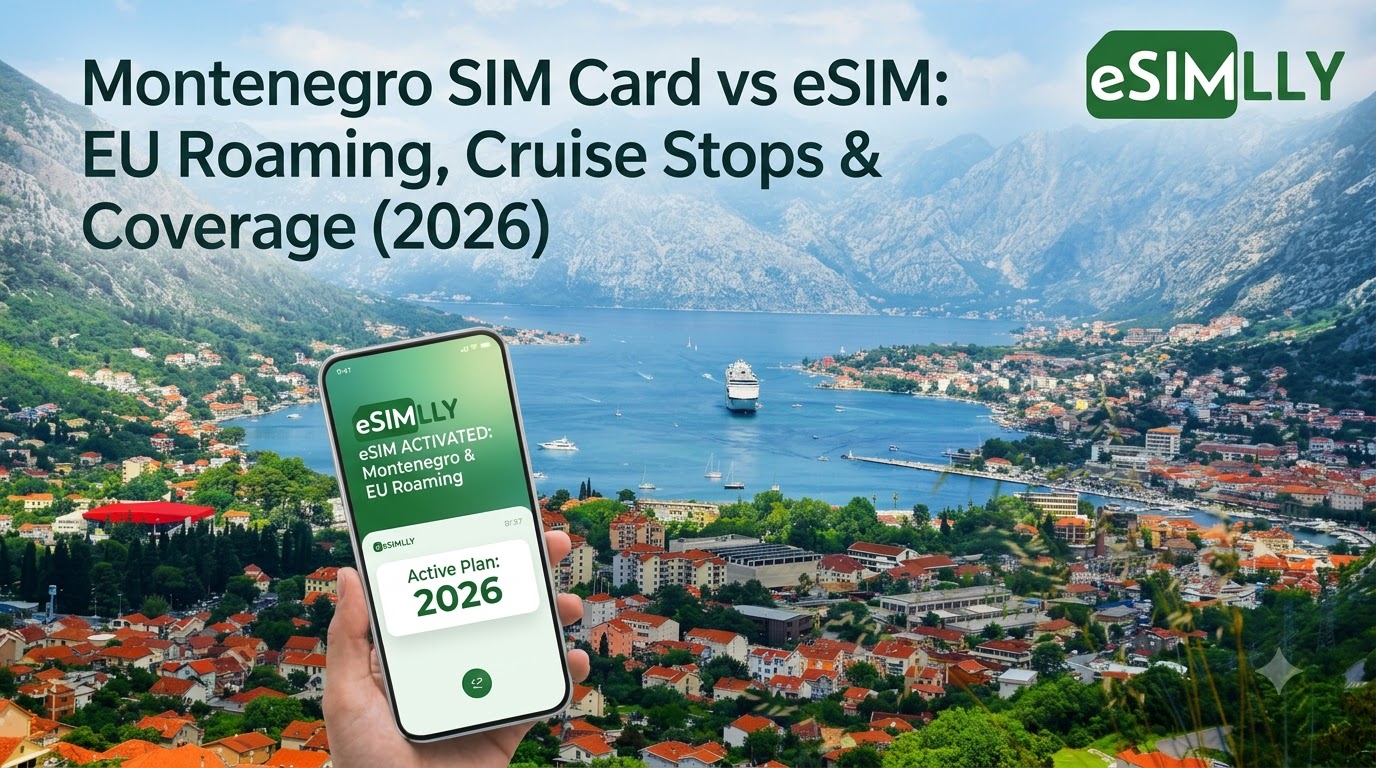
Montenegro SIM Card vs eSIM: EU Roaming, Cruise Stops & Coverage (2026)
Montenegro isn't in EU Roam Like at Home. Compare tourist SIMs and eSIMs for Kotor, Budva and Durmitor, including cruise day stops. Plans from $2.
ReadAuthor
Angelus Sharma
Published
July 27, 2026

International travel has become easier than ever. Flights can be booked within minutes, hotels can be reserved instantly, and boarding passes are stored digitally on smartphones. Yet one problem continues to surprise millions of travellers every year—unexpected mobile roaming bills.
Many travellers assume that because their phone works overseas, using it will cost roughly the same as it does at home. Unfortunately, international roaming rarely works that way.
Every year, travellers return from holidays or business trips to discover bills worth hundreds—or even thousands—of dollars because of mobile data usage they barely noticed. A few hours of navigation, uploading holiday photos, joining a video meeting, or streaming music can quickly consume expensive roaming data.
While many mobile operators now offer international roaming packs, they often come with daily charges, limited high-speed data, and country-specific restrictions. In some destinations, roaming costs remain among the highest in the world.
Fortunately, travellers now have a smarter alternative. Travel eSIMs make it possible to activate affordable mobile data before departure, eliminating many of the hidden costs associated with traditional roaming.
In this guide, we'll explore the 50 countries where tourists commonly face the highest roaming charges, explain why roaming is expensive in these destinations, and show how travellers can avoid unnecessary mobile bills.
Many travellers assume roaming costs are determined by the destination country.
In reality, pricing depends on agreements between your home mobile operator and foreign network providers.
When you travel abroad, your carrier pays another operator for access to its network. Those wholesale costs, combined with administrative fees and commercial pricing strategies, are passed on to customers.
Other factors that increase roaming costs include:
Premium telecom markets
Remote geography
Limited network competition
Island infrastructure
Satellite connectivity
High operating costs
Country-specific regulations
The result is that two travellers standing side by side in the same country can pay completely different roaming rates depending on their home carrier.
The following destinations are among those where international travellers frequently experience higher roaming costs compared with local prepaid mobile plans or travel eSIMs.
Rank | Country | Why Roaming Is Often Expensive |
|---|---|---|
1 | Switzerland | Outside many regional roaming agreements |
2 | United Arab Emirates | Premium telecom pricing |
3 | Japan | High-quality but premium mobile networks |
4 | South Korea | Premium international carrier agreements |
5 | Maldives | Island infrastructure |
6 | Iceland | Small telecom market |
7 | Norway | High network operating costs |
8 | Greenland | Remote connectivity |
9 | Australia | Large nationwide coverage |
10 | New Zealand | Geographic isolation |
11 | Canada | Large rural infrastructure |
12 | United States | Premium roaming agreements |
13 | Mexico | Carrier-dependent pricing |
14 | Qatar | Premium mobile market |
15 | Saudi Arabia | International visitor demand |
16 | Singapore | Premium network quality |
17 | Thailand | Roaming often costs far more than local data |
18 | Indonesia | Thousands of islands |
19 | Vietnam | International roaming agreements |
20 | Philippines | Island connectivity costs |
21 | China | Carrier partnership pricing |
22 | Hong Kong | Separate roaming arrangements |
23 | Taiwan | Premium international pricing |
24 | Turkey | Outside many regional roaming schemes |
25 | Israel | Premium mobile market |
26 | Egypt | International agreements |
27 | Morocco | Limited roaming bundles |
28 | South Africa | Premium international rates |
29 | Kenya | Regional pricing differences |
30 | Brazil | Large geographical coverage |
31 | Argentina | Variable roaming costs |
32 | Chile | Long-distance infrastructure |
33 | Peru | Mountainous regions |
34 | India | Depends heavily on the traveller's home carrier |
35 | Nepal | Mountain terrain |
36 | Sri Lanka | International pricing |
37 | Fiji | Island connectivity |
38 | Mauritius | Small island market |
39 | Seychelles | Premium tourism destination |
40 | Oman | Premium Gulf pricing |
41 | Bahrain | International agreements |
42 | Kuwait | Premium mobile operators |
43 | Jordan | Regional carrier pricing |
44 | Georgia | Outside major roaming zones |
45 | Armenia | Limited international agreements |
46 | Kazakhstan | Large land area |
47 | Mongolia | Sparse network infrastructure |
48 | Namibia | Low population density |
49 | Botswana | Regional network costs |
50 | Tanzania | Tourist roaming premiums |
Europe is often associated with affordable travel, but roaming costs vary significantly depending on the country.
Travellers visiting Switzerland, Norway, Iceland, and Turkey are often surprised because these destinations may not be included in every international roaming package.
A traveller visiting Paris, Milan, and Zurich during the same holiday may discover that Switzerland generates significantly higher roaming costs than neighbouring countries.
For people planning European rail trips or multi-country holidays, using a regional travel eSIM is often much simpler than relying on separate roaming agreements.
The United States, Canada, and Mexico receive tens of millions of international visitors every year.
Although mobile infrastructure is excellent, roaming costs remain relatively high for many overseas travellers.
Business visitors often consume large amounts of mobile data through:
Microsoft Teams
Zoom
Google Meet
Cloud storage
Navigation
Mobile hotspots
Even short business trips can generate surprisingly large roaming bills.
Asia is one of the world's fastest-growing tourism regions.
Popular destinations include:
Japan
South Korea
Singapore
Thailand
Indonesia
Vietnam
China
Many travellers spend weeks exploring several countries.
Changing physical SIM cards every few days quickly becomes inconvenient.
Travel eSIMs provide a far simpler solution.
Countries including:
United Arab Emirates
Qatar
Saudi Arabia
Oman
Bahrain
Kuwait
are major hubs for tourism, aviation, exhibitions, and international business.
However, they are also destinations where international roaming costs frequently exceed local prepaid mobile pricing.
Travellers attending conferences or exhibitions often benefit from activating a travel eSIM before departure.
Australia and New Zealand remain among the world's most popular long-haul destinations.
Visitors typically spend two or three weeks exploring multiple cities.
Navigation alone can consume several gigabytes of mobile data.
Streaming music during long road trips, uploading holiday photographs, and sharing travel videos increases usage even further.
Africa continues attracting increasing numbers of tourists.
Popular destinations include:
South Africa
Kenya
Morocco
Egypt
Tanzania
Network quality has improved significantly, but international roaming often remains considerably more expensive than purchasing dedicated travel data.
Travellers visiting:
Brazil
Argentina
Chile
Peru
often combine several countries into one extended holiday.
Using roaming throughout the journey may become expensive.
Regional travel eSIMs offer a more flexible approach.
Many travellers believe they only use mobile data when actively browsing the internet.
Unfortunately, smartphones consume data continuously in the background.
Common examples include:
Photo backups
Cloud synchronisation
Email refresh
App updates
Weather updates
Messaging backups
Navigation services
Smartwatch synchronisation
Calendar updates
These activities continue even when the phone appears idle.
Imagine you're spending a week in Japan.
You upload fifty holiday photographs every day.
You navigate between train stations.
You stream music during transport.
You make several video calls home.
Without realising it, you've consumed several gigabytes of data.
If you're relying on expensive roaming, that usage could become one of the most expensive parts of your trip.
Many travellers only think about connectivity after arriving.
By then, their phone has already:
Downloaded emails
Updated apps
Uploaded photographs
Synced cloud storage
Refreshed social media
Every background process contributes to roaming costs.
Planning before departure is almost always the smarter option.
Travel habits are changing.
Rather than waiting until arrival, more travellers now activate mobile data before boarding their flight.
A travel eSIM provides several advantages.
Know your costs before travelling.
Plans are delivered digitally.
Nothing needs replacing.
Regional plans simplify longer trips.
Many phones allow your home SIM to remain active while using an eSIM for data.
Feature | International Roaming | Travel eSIM |
Pricing | Often unpredictable | Prepaid and transparent |
Activation | Automatic | Digital installation |
Physical SIM Required | Existing SIM | No |
Multi-country Plans | Limited | Widely available |
Unexpected Bills | Possible | Much less likely |
Easy Top-ups | Depends on carrier | Usually online |
For most international travellers, travel eSIMs provide greater flexibility and more predictable costs.
If you're travelling internationally, these simple habits can significantly reduce mobile expenses.
Install a travel eSIM before departure.
Download offline maps.
Turn off automatic app updates.
Restrict photo backups to Wi-Fi.
Disable unnecessary background app refresh.
Monitor mobile data usage daily.
Connect to trusted Wi-Fi for large downloads.
These small changes can prevent expensive surprises after your trip.
Rather than paying premium roaming charges every time you travel internationally, you can prepare your connectivity before leaving home.
eSIMLLY offers travel eSIM plans for more than 150 countries and regions, making it easy to stay connected whether you're travelling to Europe, North America, Asia, the Middle East, Oceania, Africa, or South America.
With instant digital delivery, straightforward activation, transparent pricing, and destination-specific or regional plans, travellers can avoid the inconvenience of searching for local SIM cards while reducing the risk of expensive roaming bills.
Whether you're taking a short holiday, attending an international conference, backpacking across continents, or visiting several countries in one trip, eSIMLLY helps make mobile connectivity simple from the moment you land.
International roaming remains one of the most overlooked travel expenses.
While many travellers carefully compare flights and hotels to save money, they often forget that mobile connectivity can quietly become one of the largest costs of the trip.
The countries listed in this guide are among the destinations where roaming costs are frequently higher due to geography, carrier agreements, market conditions, or infrastructure. That doesn't mean every mobile operator charges the same rates—your final cost always depends on your home carrier and the roaming package you choose. However, these destinations are consistently known for generating higher roaming bills for international visitors.
The good news is that travellers have more choices than ever before. Travel eSIMs have transformed international connectivity by providing affordable, digital-first alternatives that can be activated before departure.
Instead of worrying about daily roaming charges or returning home to an unexpectedly high phone bill, you can travel with predictable costs, reliable mobile data, and the confidence that you're connected wherever your journey takes you.
As international travel continues to grow, planning your mobile connectivity before boarding your flight is becoming just as important as booking your accommodation or arranging travel insurance. It's a small step that can save money, reduce stress, and make every trip smoother from the very first day.
The future of travel is connected, digital, and increasingly seamless—and embedded eSIMs are becoming one of the technologies making that future possible.
As more travellers, enterprises, and device manufacturers embrace eSIM technology, China is set to become one of the most influential markets in shaping the future of mobile communication—and providers like eSIMLLY are well positioned to help international travellers stay connected across China and more than 150 destinations worldwide.
Instant activation, hotspot included and no roaming fees in the destinations from this guide.
Montenegro isn't in EU Roam Like at Home. Compare tourist SIMs and eSIMs for Kotor, Budva and Durmitor, including cruise day stops. Plans from $2.
Read
Zvartnots airport SIM or eSIM? Compare Armenia's operators, tourist bundle prices and when each option makes sense. eSIM plans from $2.50.
Read
Beeline, Kcell or Tele2? Why foreign phones on Kazakh SIMs need IMEI registration, and when a travel eSIM is easier. Plans from $1.50.
ReadGet instant data and savings on your next trip with eSIMLLY. Simple activation, no physical SIM card needed.


